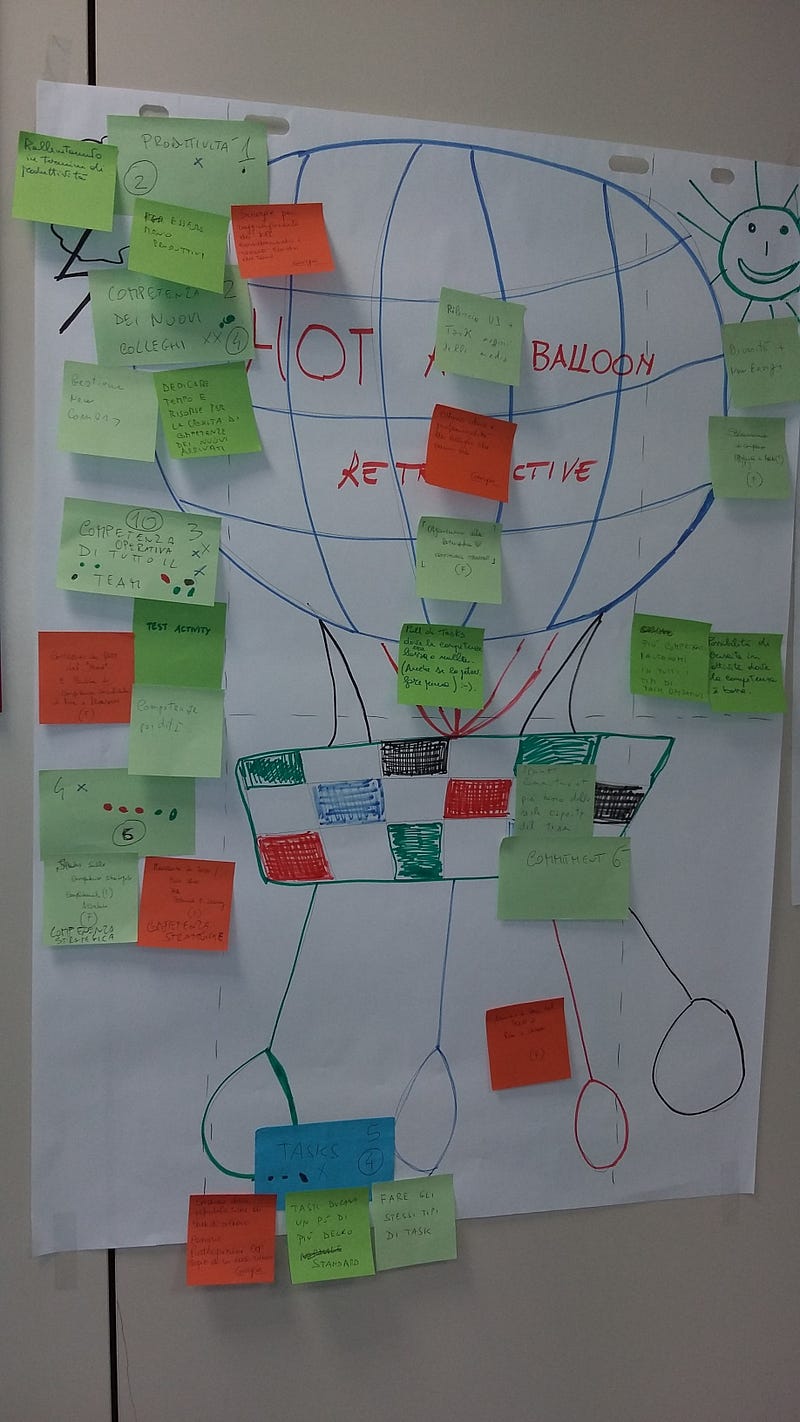
The Lean Coffee is a structured, but agenda-less gathering that provides a framework for deep conversations and productive networking with colleagues. Participants collaborate to quickly identify their agenda.
As ScrumMaster, inspired by its totally open meeting format, I figured out this could be an excellent alternative to the “what did we do well, what do we want to change, what do we want to add” formula for retrospective, that is likely not inspirational enough to break team members out their well-worn thinking patterns. So I always ask myself if I’m doing a good job for them by breaking out their well well-worn patterns to offer them new ways to inspect how they work together.
Lean Coffee framework uses Kanban to structure meetings. It democratizes meetings to learn and discover things about what we don’t know in advance, as well as exploring further what we know.
Sounds good as alternative to boring retrospectives isn’t it?
At the start, the ScrumMaster creates a Kanban board with a backlog, WIP, and “To Discuss”, “Discussing” and “Discussed” columns on the table.
Each participant writes down her desired topics, one per sticky note, to place in the backlog, i.e. in the “To Discuss” column. Each person gets a chance to quickly explain her topics. The participants in the retrospective dot-vote for prioritizing the backlog. And then, they’re off on a time-boxed discussion of the top priority topic.
When the timer politely dings, the group can elect to continue for another block of time or call that discussion done and switch to the next topic. I was surprised at how the group gives each topic its due then moves seamlessly to the next. I was also surprised how many great ideas can be shared within a short time period. They can also share “aha” moments and takeaways to wrap up.
Here’s more details how we ran it
Step 1: Float: Everybody floats their ideas by adding notes on topics they’d like to discuss, placing them in the “To Discuss” column. Give as much time as needed, but typically takes only 3-5 minutes. Limit ideas to 2-3 per participant to help focus voting.
Step 2: Promote: Each writer describes their topics briefly: 15-30 seconds or 1-2 sentences typically per note.
Step 3: Vote: Each person gets votes which they indicate by editing their choice of notes and adding “+1”. They can put all their votes on one note.
Step 4: Tote: The top three notes are carried over to the “Discussing” column, with the notes having the most votes at the top.
Step 5: Throat: Each of these notes is discussed for about 20 minutes. When the ScrumMaster thinks the discussion has reached a good end-point he asks if everyone is complete.
When the process is complete, the ScrumMaster can add comments to the note and move it the “Discussed” column.
Repeat until all are discussed. If enough time is left over, do another note or two.
Step 6: Note: ScrumMaster guides team to decide what to do, with discussed items in order to come out with an action plan for each topic and captures commitments in backlogged “process improvement”.
I have experienced some small variations for the name of this type of retrospective in order to have more fun with team. One time I named the retrospective “Lean Ice Cream”, with an equal format to the Lean Coffee but with the change that the Product Owner offered us a delicious ice cream.
After the latest Sprint Retrospective, using the Lean Coffee framework, a colleague of mine provided me a proposal in order to add some variations.
After his proposal I was hyper to write an article, including his suggestion, in order to share this experience with the world.
Since only the top three notes are carried over to the “Discussing” column, it’s possible that some valid topics are not discussed and someone could feel not listened or that some topic couldn’t be given the right attention, only because it was not in top three. I agreed with my team that some left topics in the backlog could be discussed during the sprint, reserving one or maximum two time box meetings of a half an hour each, instead to postpone the discussion to the next retrospective, when some topics could result much more heavy or related to not handled risks, because not faced in current sprint.
We went through one mini-retrospective, in the middle of latest sprint that we named “Continuous Retrospective” meeting of half an hour; in addition to that one we had at the end of previous sprint.
It was an exciting experience, because we were able to discuss two main topics left in the latest lean coffee retrospective backlog, finding improvements and a quick action plan for each of them.
When the time was up, some team members said “Yes, it was great, we were really agile” or “all retrospectives should be like this one” or “We were very effective”. For me it was a great experience and my team colleagues felt motivated, because we were experiencing together a new retrospective formula and at last no one was bored.
At the end I said: “Goodbye until our next Lean Coffee Continuous Retrospective…maybe next time we will call it Lean Cake because I’ll offer you a delicious homemade cake”.
Summary
The Lean Coffee is a structured, but agenda-less gathering that can be used as alternative to classical framework for retrospectives. Participants collaborate to quickly identify their agenda. Some enhancements have been briefly described in this article, allowing covering all topics proposed to discuss by development team.
References and suggested resources
http://www.lulu.com/shop/francesco-attanasio/retrospectives-workout/ebook/product-22606494.html